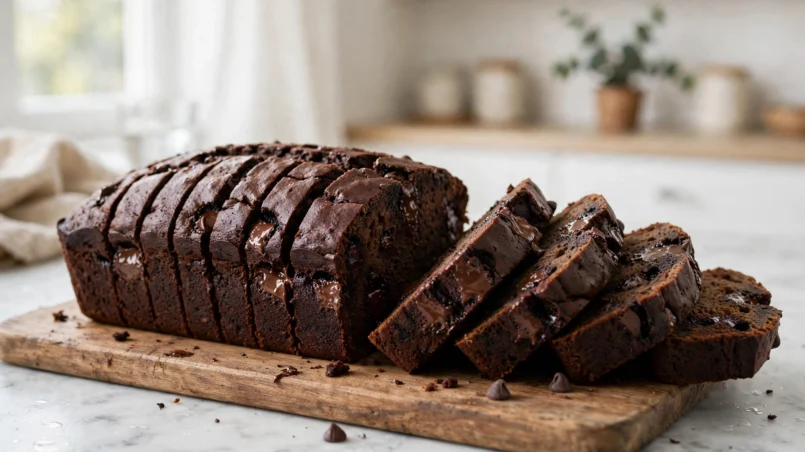
Last updated on November 24, 2026
There is a bunch of bananas on my counter right now that has gone past yellow, past spotted, and into that dark, freckled stage where most people throw them away. I never throw them away, because those are the best bananas in the house — the ones that are sweet enough and soft enough to make this loaf. This chocolate banana bread recipe is the recipe those bananas were waiting for: a fudgy double chocolate banana bread, cocoa in the batter and a cup of chocolate chips folded in, fifteen minutes of work, one loaf pan, and about an hour in the oven while the kitchen smells like a bakery. It is the first loaf on Chocolacious, and the first baked thing here that is not a cake, a brownie or a mug cake — and it is the one that rescues fruit that would otherwise go in the bin.
Chocolate banana bread fails in two ways, and this recipe is built around both of them: a dry, tough loaf from over-mixing, and a wet, sunken centre from under-baking. The fix is in the mixing and in the doneness test — stir the dry ingredients in only until they are just incorporated, because a few lumps are fine and over-mixing develops gluten and makes the loaf tough, and do not trust the clock alone: bake 55 to 65 minutes at 350°F, then check the centre with a toothpick, which must come out clean, or with an instant-read thermometer, which must read 200 to 205°F. That centre-temperature test, plus the do-not-over-mix rule, is why this chocolate banana bread recipe works every time. If you want the same chocolate served cold and creamy instead of in a warm slice, try a slice beside a scoop of our chocolate ice cream recipe — no-churn, five ingredients, and the cold half of this dessert.
In This Article
- Why This Recipe Works
- Ingredients
- How to Make Chocolate Banana Bread
- The Doneness Guide
- Pro Tips and Troubleshooting
- Variations
- How to Serve and Store
- Frequently Asked Questions
- More Recipes You Will Love
Why This Recipe Works
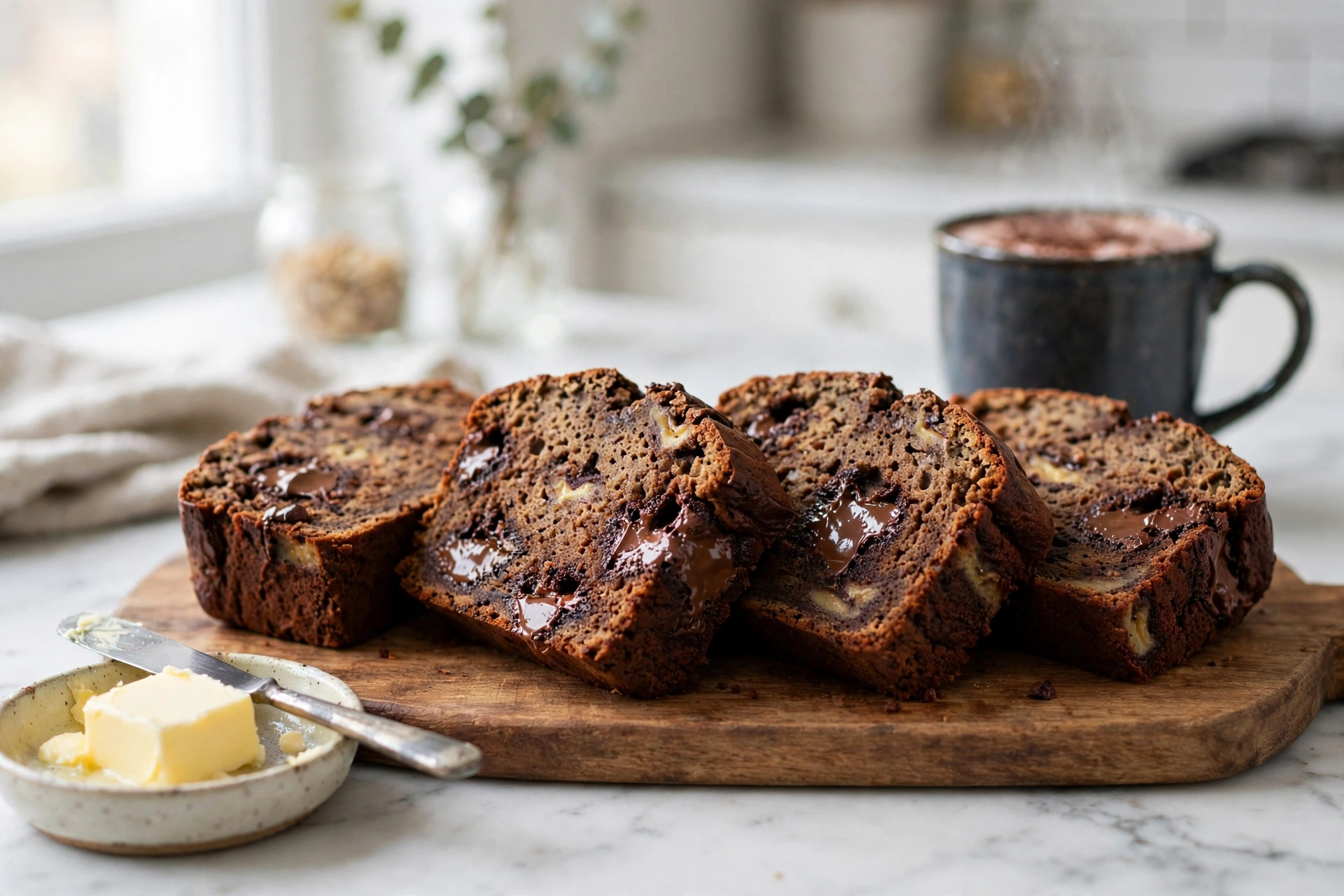
Very ripe bananas are the whole foundation of this loaf. A banana that is brown-spotted and very soft has converted much of its starch to sugar, so it is sweeter than a yellow banana, and it mashes smoother, so it folds into the batter as a wet ingredient rather than sitting in it as lumps. That is why the ripest bananas make the moistest loaf: they sweeten and moisten it without extra sugar, and they carry the banana flavour all the way through the crumb instead of leaving it in pockets. Under-ripe bananas do the opposite — they are starchy, dry and bland, and a loaf made with them tastes like chocolate bread with banana in the name only. If your bananas are not ripe enough, wait a day or two, or speed them up in a 300°F oven for fifteen minutes until the skins go black and the fruit inside is soft. The bananas in the photo are exactly right: yellow skins covered in brown freckles, soft when you squeeze them, sweet when you taste them.
The second piece is the cocoa, and the kind matters. This recipe uses natural unsweetened cocoa powder, not Dutch-process, because natural cocoa is acidic and the baking soda in the recipe is alkaline — the two react in the oven and the reaction is what lifts the loaf. Dutch-process cocoa has been treated to remove that acidity, so the lift is weaker and the loaf comes out denser and flatter, even though the chocolate flavour is still there. Natural cocoa is the tested pair for this recipe, and it is the one on the card. The third piece is the creaming: beating the softened butter and the sugar together first traps tiny air bubbles in the fat, and those bubbles expand in the oven and lighten the crumb — it is the difference between a loaf that is tender and one that is dense. And the fourth piece is the chips, folded in last, so they stay suspended in the thick batter instead of sinking to the bottom of the pan, where they would form a chocolate layer instead of melted pockets.
The last piece is the doneness test, and it is the one that saves the loaf. A chocolate banana bread looks done on top long before the centre sets — the dark crust browns early, the top cracks and looks finished, and a loaf pulled at that moment sinks in the middle as it cools, because the centre was still wet batter. Time alone cannot tell you when it is done, because ovens run hot and cold and loaf pans differ. The toothpick in the centre can: it must come out clean, and melted chocolate on the toothpick does not count — chocolate is not batter, and a smear of melted chip is not a wet centre. Better still is a thermometer: 200 to 205°F in the centre means the crumb has set all the way through, and that number is the only reliable doneness check there is. Bake to the number, not to the clock, and the loaf never sinks.
Ingredients
Ten ingredients, one loaf pan, and nothing exotic — the bananas do the sweetening, the cocoa does the chocolate, and the chips do the melting. The cocoa note comes first because it is the one ingredient that changes the result if you swap it: use natural unsweetened cocoa powder, not Dutch-process, because natural cocoa reacts with the baking soda and lifts the loaf, while Dutch-process cocoa has had its acidity removed and gives a weaker rise. The bananas must be very ripe — brown-spotted, very soft, about one and three-quarter cups when mashed — and the butter must be softened, not melted, so it creams with the sugar instead of turning the batter greasy.
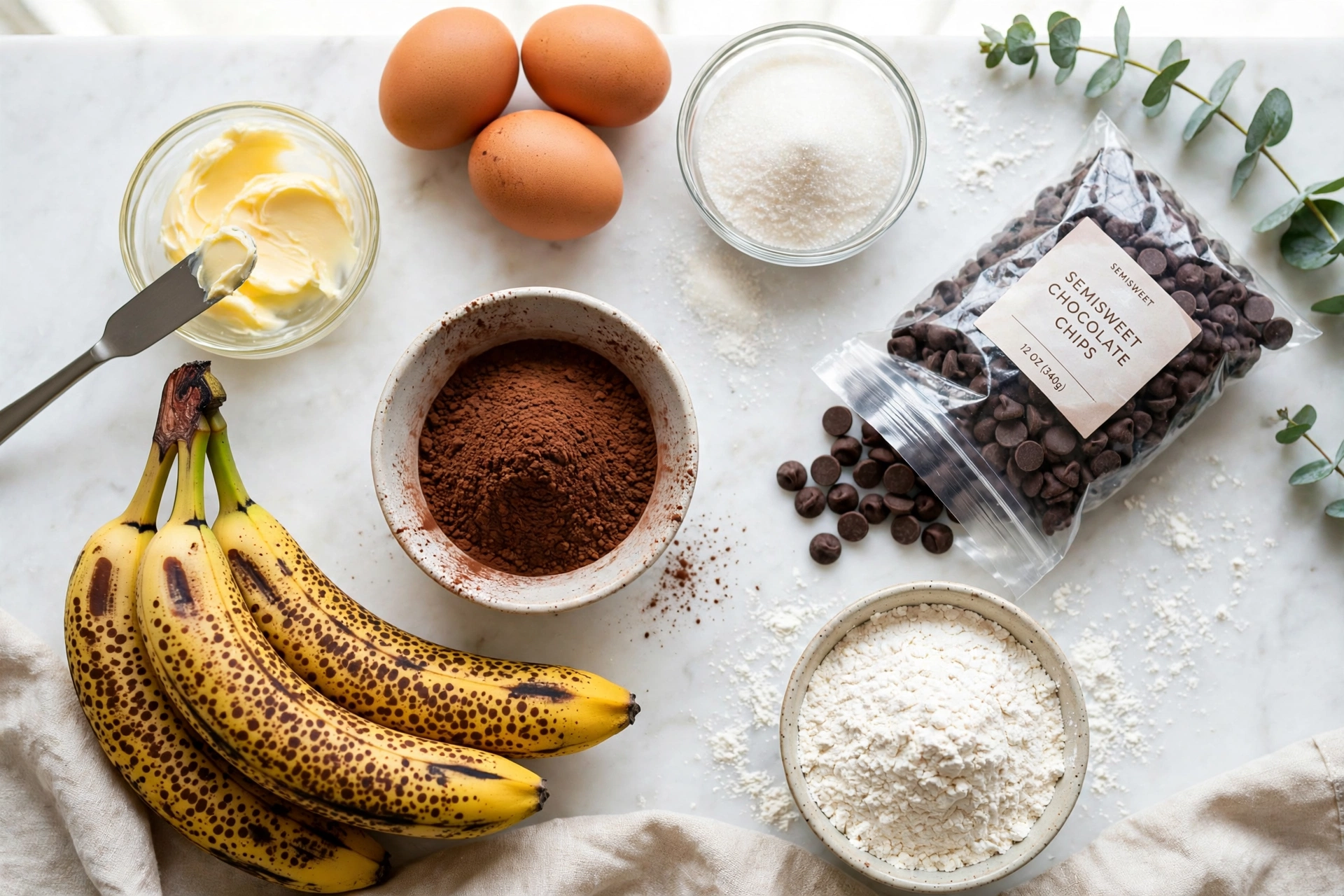
- 3 very ripe bananas, mashed with a fork — about 1 3/4 cups. Brown-spotted and very soft is the test: under-ripe bananas make a dry, bland loaf, because they are starchy instead of sweet and they do not mash smooth.
- 2/3 cup (133 g) granulated sugar — the bananas carry much of the sweetness, so this is all the added sugar the loaf needs. Cream it with the butter until it is pale and fluffy.
- 1/2 cup (113 g) unsalted butter, softened — softened, not melted: it must cream with the sugar and trap air, which is what lightens the crumb. Leave it on the counter for an hour, or cut it into cubes and wait twenty minutes.
- 2 large eggs, lightly beaten, at room temperature — room temperature eggs mix into the batter evenly, while cold eggs can make the creamed butter seize back up into lumps. Take them out of the fridge when you take the butter out.
- 1/2 teaspoon vanilla extract — a small amount, but it rounds out the banana and chocolate instead of letting either one shout. Use real extract, not imitation, if you have it.
- 1 cup (125 g) all-purpose flour — spoon it into the measuring cup and level it off, or weigh it: a packed cup is up to a quarter-cup too much flour, and too much flour is the fastest way to a dry loaf.
- 1/3 cup (28 g) natural unsweetened cocoa powder — natural, not Dutch-process. The acidity in natural cocoa reacts with the baking soda and lifts the loaf; Dutch-process cocoa has had that acidity removed, so the rise is weaker.
- 1 teaspoon baking soda — the leavener, and the partner of the natural cocoa. Do not swap in baking powder: this recipe has no other acid to activate it, and the lift comes from the cocoa-and-soda reaction.
- 1/2 teaspoon sea salt — salt makes chocolate taste more like chocolate, the same way it does in every recipe on this site. Do not skip it, and do not use a full teaspoon unless your butter is unsalted and your taste runs salty.
- 1 cup (175 g) semisweet chocolate chips, divided — 3/4 cup folded into the batter, 1/4 cup sprinkled on top before baking. The folded chips melt into pockets inside the loaf; the top chips go glossy and crisp on the crust.
A note on the cocoa: check the tin before you buy. If it says “natural” or just “unsweetened cocoa powder”, it is the right one. If it says “Dutch-process”, “alkalised” or “processed with alkali”, it is the wrong one for this recipe — it will still taste like chocolate, but the loaf will be denser and flatter, because the baking soda has no acid left to react with. The same rule applies to the chips: semisweet is the right sweetness here, because the bananas are already sweet. Milk-chocolate chips make the loaf sweeter and softer, dark-chocolate chips make it sharper and less sweet, and both work — but semisweet is the tested version, and the one the card is written for.
How to Make Chocolate Banana Bread
Ten steps, fifteen minutes of active work, and then about an hour in the oven while the loaf bakes and the kitchen fills with the smell of chocolate and banana. The only skill in this recipe is restraint: stir the dry ingredients in only until they disappear, and stop. A few lumps in the batter are fine — they bake out. Over-mixing is the one mistake that cannot be undone, because it develops the gluten in the flour and turns a tender loaf tough. Read the doneness guide below before you start, because the toothpick test and the 200 to 205°F thermometer reading are the recipe, and the difference between a loaf that slices cleanly and a loaf that sinks in the middle is decided in the last ten minutes of baking, not in the mixing.
- Preheat the oven and prepare the pan. Heat the oven to 350°F and grease a 9.25 x 5.25-inch loaf pan, then line it with parchment paper with overhang on the two long sides. The overhang is the handle that lifts the loaf out later — without it, a fudgy loaf sticks, and prying it out breaks the crust. Grease the parchment lightly too, so nothing catches.
- Mash the bananas. Peel the three very ripe bananas into a bowl and mash them with a fork until they are mostly smooth, with a few small lumps left — about one and three-quarter cups. Do not use a blender or a food processor: they make the bananas runny, and runny bananas make a wet batter that bakes into a gummy centre. A fork and thirty seconds is the whole job.
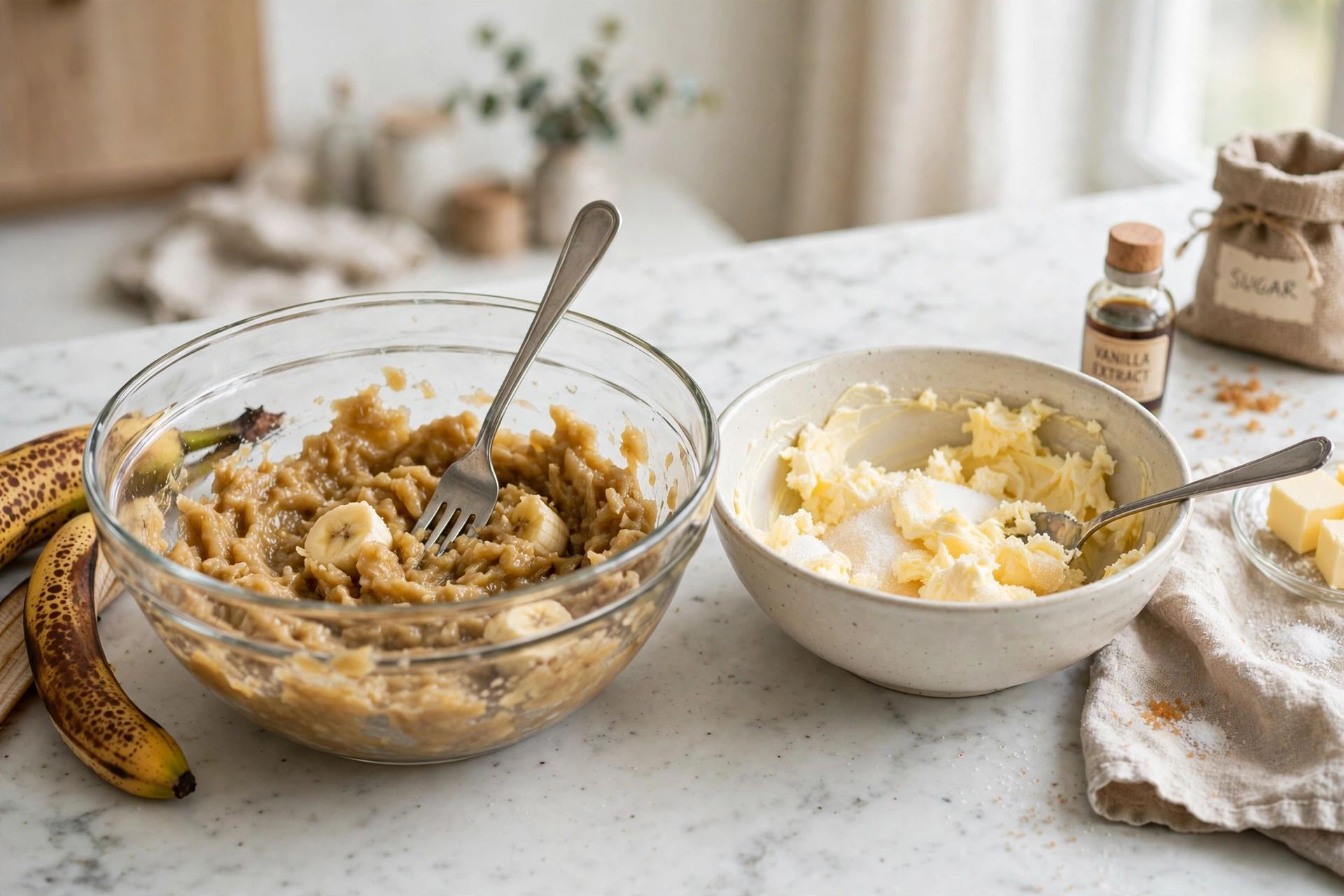
- Cream the butter and sugar. In a large bowl, beat the softened butter and the granulated sugar together on medium speed for about two minutes, until the mixture is pale, fluffy and lighter in colour. This step traps the air that lightens the crumb, so do not rush it — two full minutes, not thirty seconds. Scrape the bowl down once halfway through so no butter hides at the bottom.
- Add the eggs, bananas and vanilla. Beat in the two lightly beaten eggs, one at a time, mixing just until each one disappears. Then mix in the mashed bananas and the vanilla extract, again just until combined. The mixture will look a little curdled at this point — that is normal, and it smooths out as soon as the dry ingredients go in. Do not keep beating it to make it pretty.
- Sift the dry ingredients together. In a second bowl, sift together the flour, the natural cocoa powder, the baking soda and the sea salt. Sifting matters here more than in most recipes, because cocoa powder clumps — and a clump of cocoa in the batter becomes a bitter pocket in the finished loaf. If you do not have a sifter, whisk the dry ingredients together for a full thirty seconds, which breaks up most of the clumps.
- Add the dry ingredients to the wet — and stop early. Add the sifted dry ingredients to the wet bowl and stir on medium-low speed, or by hand with a spatula, only until the flour disappears and the batter is just combined. A few lumps are fine. This is the step that decides whether the loaf is tender or tough: over-mixing develops the gluten in the flour, and gluten is what makes bread chewy and banana bread dry. Stop the moment you cannot see dry flour any more.
- Fold in the chocolate chips. Add 3/4 cup of the semisweet chocolate chips and fold them in with a spatula, three or four gentle strokes, until they are evenly distributed. Fold them in last — never before the flour — because folding them into a thin, early batter lets them sink, while folding them into the finished thick batter keeps them suspended. If your chips always sink, toss them in a spoonful of flour first: the flour coats them and holds them in place.
- Pan it and top it. Spread the batter evenly in the prepared loaf pan and smooth the top with the spatula, pushing the batter slightly toward the corners so the loaf rises evenly instead of doming in the middle. Sprinkle the remaining 1/4 cup of chocolate chips over the top — these are the ones that go glossy and crisp on the crust, and they are also the sign that the loaf is chocolate before anyone cuts it.
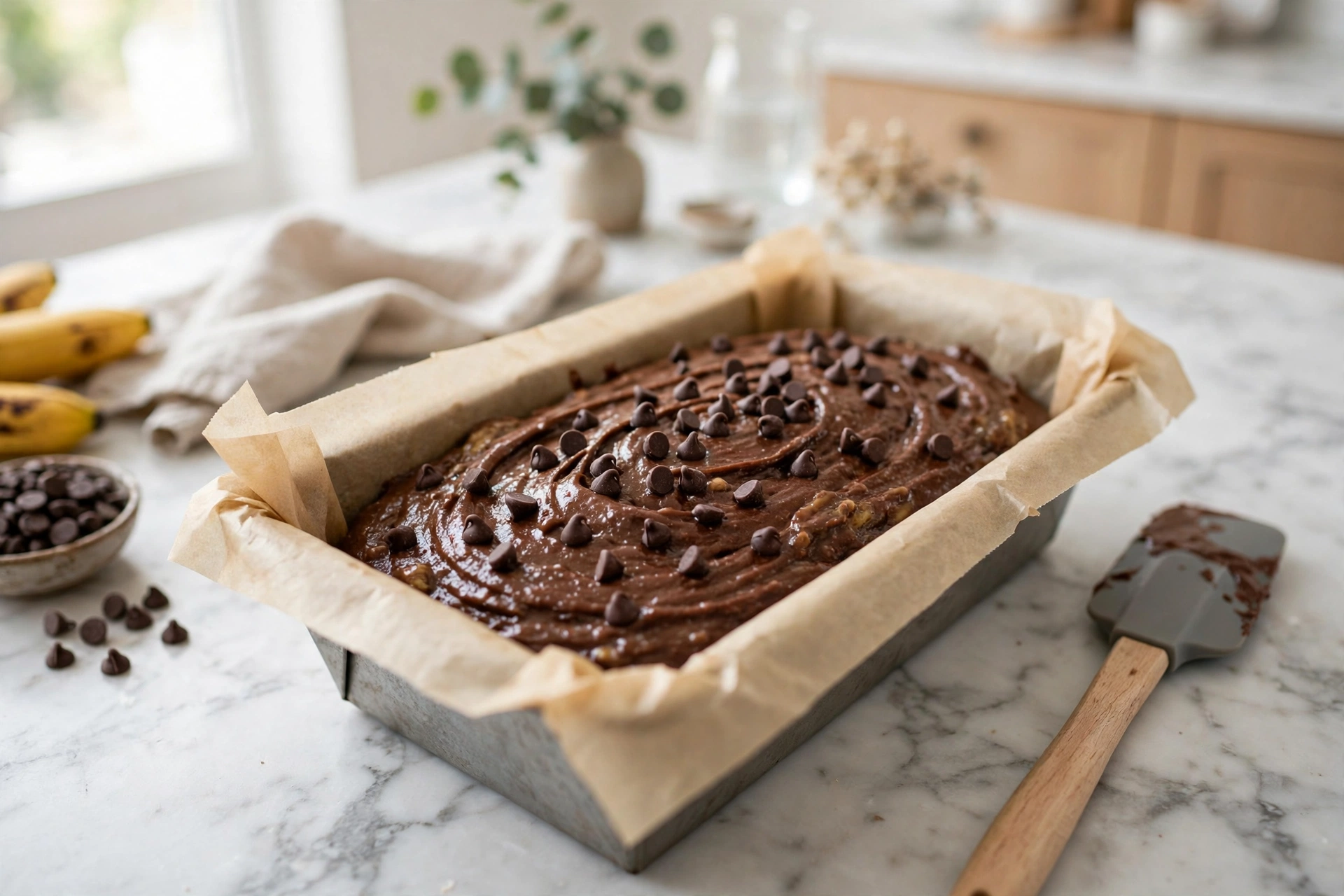
- Bake 55 to 65 minutes at 350°F. Bake until a toothpick pushed into the centre comes out clean — melted chocolate on the toothpick does not count — or until an instant-read thermometer reads 200 to 205°F in the centre. Start checking at 55 minutes. If the top is browning too fast before the centre is done, tent the pan loosely with foil after about 45 minutes and keep baking: the foil slows the top while the centre catches up. Do not open the oven door before 45 minutes, or the loaf can fall.
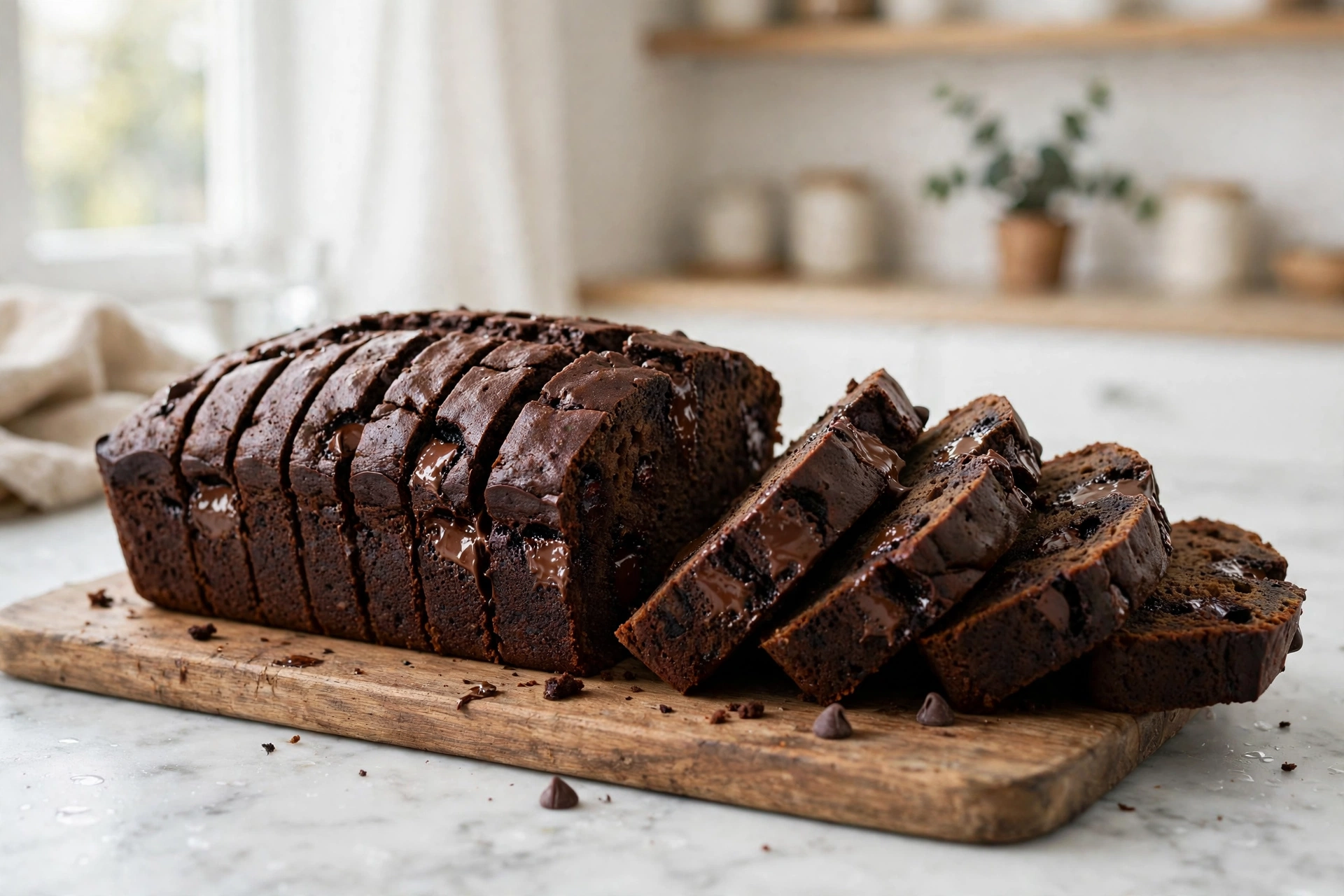
- Rest, lift and cool before slicing. Let the loaf rest in the pan for 10 minutes, then lift it out by the parchment overhang and set it on a wire rack to cool completely before slicing — at least 30 minutes. A warm loaf is a fragile loaf: slicing it hot crumbles the crumb and the chocolate pockets run out instead of staying in the slice. Room temperature is when it slices cleanly, and warm with butter is when it tastes best.
The Doneness Guide
The bake is the recipe, so here it is as a table. Fifty-five to sixty-five minutes at 350°F is the window, and the centre test is the decision — not the clock, not the colour of the top, and not the smell. A loaf that looks done on top is often still wet in the middle, and a loaf pulled early sinks as it cools and never comes back.
| Stage | Time | What to Look For |
|---|---|---|
| Preheat and prep | Before you start | Oven at 350°F; pan greased and lined with parchment overhang |
| Active work | About 15 minutes | Mash, cream, mix, fold, pan — everything done before the oven |
| Bake | 55 to 65 minutes | Top cracked and set; do not open the door before 45 minutes |
| Toothpick test | From 55 minutes | Toothpick in the centre comes out clean — melted chocolate does not count |
| Thermometer test | From 55 minutes | Centre reads 200 to 205°F — the only reliable doneness check |
| Rest in the pan | 10 minutes | Loaf firms up enough to lift out on the parchment without breaking |
| Cool before slicing | At least 30 minutes | Completely cool on a wire rack — a warm loaf crumbles when sliced |
How to tell it is done: push a toothpick into the exact centre of the loaf, not the edge — the edges set twenty minutes before the centre does, and a clean toothpick at the edge tells you nothing. If it comes out with wet batter on it, give the loaf five more minutes and test again. If it comes out with a smear of melted chocolate, that is a chip, not batter — test a different spot. The thermometer is the surer test: 200 to 205°F in the centre means the crumb has set all the way through. Below 200°F, the centre is still wet and the loaf will sink. Above 205°F, the loaf is over-baked and drying out. Between the two numbers is where a fudgy, moist loaf lives, and it is a small window — which is why the thermometer is worth owning.
Pro Tips and Troubleshooting
Most chocolate banana bread problems have one of six causes, and all six are easy to fix — or to avoid entirely. Here they are, with the fix for each:
- Dry, tough loaf: over-mixed after the flour went in. Stir the dry ingredients in only until they disappear, and stop — a few lumps are fine. Over-mixing develops gluten, and gluten is what makes the crumb tough instead of tender. The other cause is too much flour: spoon the flour into the cup and level it off, or weigh it, because a packed cup is up to a quarter-cup too much.
- Sunken, wet centre: under-baked. The loaf was pulled before the centre set, and it sank as it cooled. Bake the full 55 to 65 minutes and check the centre, not the edges — the toothpick must come out clean in the middle, or the thermometer must read 200 to 205°F. If the top is browning too fast, tent it with foil and keep baking; the centre needs the time.
- Top browning too fast: the oven runs hot, or the pan sits too high. Tent the loaf loosely with foil after about 45 minutes and keep baking — the foil slows the top while the centre catches up. Next time, bake on the middle rack, and check the oven with a thermometer: many ovens run 25°F hotter than the dial says.
- Chocolate chips all sunk to the bottom: the batter was too thin when the chips went in, or they were folded in too early. Fold the chips in last, into the finished thick batter, and toss them in a spoonful of flour first — the flour coats them and holds them suspended instead of letting them sink.
- Loaf stuck in the pan: no parchment, or no overhang to lift it by. Line the pan with parchment with overhang on the two long sides and grease it lightly — the overhang is the handle, and a fudgy loaf without one has to be pried out, which breaks the crust. If it is stuck now, run a thin knife around the short ends and lift gently from both sides.
- Bland chocolate flavour: Dutch-process cocoa, or too little cocoa. Use natural unsweetened cocoa and the full 1/3 cup — the recipe is written for it, and Dutch-process cocoa gives a weaker flavour as well as a weaker rise. A pinch more salt also helps: salt makes chocolate taste more like chocolate, and an under-salted loaf tastes flat even when the chocolate is right.
Two more tips worth knowing: use the ripest bananas you have — brown-spotted, very soft, sweet when you taste them raw — because under-ripe bananas are the single biggest cause of a dry, bland loaf, and no amount of sugar fixes them. And let the loaf cool completely before slicing: a warm loaf crumbles, the chocolate pockets run out, and the slices fall apart in your hands. Room temperature is when it slices cleanly — and a warm slice with butter, reheated for ten seconds in the microwave, is when it tastes best.
Variations
Once the base recipe works, it takes variations happily — five of them, all built on the same batter, so the active work does not change:
- Walnut or pecan crunch: fold in 1/2 cup of chopped walnuts or pecans with the chocolate chips. The nuts toast in the oven and give the loaf a crunch against the fudgy crumb — the version to make when the loaf is for coffee rather than for dessert. Toast the nuts first in a dry pan for three minutes, and they taste louder.
- Peanut-butter swirl: drop spoonfuls of peanut butter over the batter in the pan and drag a knife through them in a figure-eight before baking. The swirl stays visible in the slice and the salt in the peanut butter sharpens the chocolate — the same salty-sweet idea as the sea salt on our chocolate covered pretzels, where salt makes the chocolate taste louder.
- Milk- or dark-chocolate chips: swap the semisweet chips for milk chocolate for a sweeter, softer loaf, or for dark chocolate at 70 percent for a sharper, less sweet one. The method does not change — fold them in last, sprinkle a quarter-cup on top — and the choice is yours. Dark chocolate is the version I serve with coffee; milk chocolate is the version children ask for.
- Chocolate banana muffins: the same batter, baked in a lined muffin tin for 18 to 25 minutes at 350°F, until a toothpick in the centre of a muffin comes out clean. One loaf makes about twelve muffins, and they are the version to bake when the loaf is for lunchboxes rather than for slicing. Start checking at 18 minutes — muffins bake faster than a loaf, and they dry out faster too.
- A lighter version: replace half the butter with unsweetened applesauce — a quarter-cup of butter and a quarter-cup of applesauce instead of a half-cup of butter. The loaf stays moist and a little less rich, and the banana flavour comes forward. Flag this one as a variation, not the base: the full-butter loaf is the tested recipe, and the applesauce version is lighter, not better.
Serving: a warm slice with butter is the classic, and a warm slice beside a scoop of our chocolate ice cream recipe is the dessert version — the cold, creamy ice cream against the warm, fudgy loaf is the whole contrast. Or serve it the way the loaf was made to be served: with a mug of our hot chocolate recipe, and nothing else, on a quiet morning. For a fancier finish, drizzle the cooled loaf with ganache from our chocolate ganache recipe — it sets into a glossy coat and turns a weekday loaf into a dessert-table loaf. And if you want chocolate faster than a loaf, the warm chocolate lava cake recipe is the twenty-minute version of the same craving. The no-bake strawberries from yesterday belong on the same table too — our chocolate covered strawberries recipe makes glossy, snappy berries in 45 minutes, and a berry beside a warm slice of this loaf is the easiest dessert platter in the whole collection.
How to Serve and Store
Serve the loaf at room temperature or slightly warm, sliced thick — ten slices from one loaf — with butter, or beside a scoop of ice cream, or with coffee. It is at its best in the first day, while the crust is still a little crisp and the chocolate pockets are still soft. A slice reheated for ten seconds in the microwave tastes freshly baked again, which is the trick for day two and three.
Store the loaf wrapped tightly in plastic wrap or in an airtight container at room temperature for 3 to 4 days — it stays moist that long, because the bananas keep it wet. Refrigerate it for up to 1 week, wrapped the same way, and bring slices back to room temperature or warm them for ten seconds before serving, because a cold loaf tastes dry even when it is not. Freeze it sliced, each slice wrapped separately, for up to 3 months, and thaw at room temperature — frozen slices are the lunchbox version, and they thaw by lunchtime.
Frequently Asked Questions
How ripe should the bananas be?
Brown-spotted and very soft — the riper the banana, the sweeter and moister the loaf. A yellow banana with no spots is under-ripe for this recipe: it is starchy and bland, it does not mash smooth, and the loaf comes out dry. If your bananas are not ripe enough, wait a day or two, or bake them in their skins at 300°F for fifteen minutes until the skins go black and the fruit inside is soft and sweet.
Can I use Dutch-process cocoa?
It will work, but the lift is weaker. Natural cocoa is acidic and the baking soda is alkaline, and the reaction between them is what lifts the loaf — Dutch-process cocoa has had its acidity removed, so the baking soda has nothing to react with and the loaf comes out denser and flatter. The chocolate flavour is still there, but the texture is not the same. Natural unsweetened cocoa is the tested pair for this recipe.
Why is my chocolate banana bread dry?
Two causes, and both are in the mixing and the measuring. Over-mixing after the flour went in develops gluten and makes the loaf tough — stir only until the flour disappears and stop. And too much flour dries it out — spoon the flour into the cup and level it off, or weigh it, because a packed cup is up to a quarter-cup too much. Over-baking past 205°F in the centre dries it out too, which is why the thermometer matters.
Why did my loaf sink in the middle?
It was under-baked. The top looked done long before the centre set, and the loaf was pulled while the middle was still wet batter — then it sank as it cooled. Bake the full 55 to 65 minutes and check the centre, not the edges: the toothpick must come out clean in the middle, or the thermometer must read 200 to 205°F. Opening the oven door before 45 minutes can also make a loaf fall, so leave it shut until the top has set.
Can I make muffins instead?
Yes — the same batter, baked in a lined muffin tin for 18 to 25 minutes at 350°F, until a toothpick in the centre of a muffin comes out clean. One loaf makes about twelve muffins. Start checking at 18 minutes, because muffins bake faster than a loaf and they dry out faster too. The chips, the cocoa and the doneness test are all the same.
How do I store chocolate banana bread?
Wrapped tightly or in an airtight container at room temperature for 3 to 4 days, refrigerated for up to 1 week, or frozen sliced and wrapped for up to 3 months. The bananas keep it moist at room temperature longer than most quick breads, and frozen slices thawed at room temperature taste freshly baked. Bring refrigerated slices to room temperature, or warm them for ten seconds, before serving.
Can I skip the chocolate chips?
Yes — the cocoa in the batter still makes it a chocolate banana bread, and the loaf will be a little less sweet and a little less rich. But the chips are the melted pockets, and they are half the point of the double chocolate: without them, the loaf is chocolate-flavoured banana bread, and with them, it is a fudgy chocolate loaf with banana in it. If you skip them, add the walnut variation instead, so the loaf keeps its texture.
Nutrition (Per Serving, Approximate)
Calories: 310 | Carbohydrates: 39g | Protein: 4g | Fat: 15g | Sugar: 23g
Nutrition values are estimated for 1 of 10 slices, and may vary based on exact ingredients used.
More Recipes You Will Love
| Recipe | Category |
|---|---|
| Chocolate Covered Strawberries Recipe | Chocolate Treats and Candy |
| Chocolate Ice Cream Recipe | Chocolate Treats and Candy |
| Chocolate Lava Cake Recipe | Chocolate Treats and Candy |
| Hot Chocolate Recipe | Chocolate Treats and Candy |
| Chocolate Cake Recipe | Chocolate Treats and Candy |
Chocolate Banana Bread Recipe
Ingredients
Method
- Preheat the oven to 350°F. Grease a 9.25 x 5.25-inch loaf pan and line it with parchment paper with overhang on the two long sides, then grease the parchment lightly.
- Peel the three very ripe bananas into a bowl and mash them with a fork until mostly smooth, with a few small lumps left — about 1 3/4 cups. Do not use a blender or a food processor; they make the bananas runny.
- In a large bowl, beat the softened butter and the granulated sugar together on medium speed for about 2 minutes, until pale, fluffy and lighter in colour. Scrape the bowl down once halfway through.
- Beat in the two lightly beaten eggs, one at a time, mixing just until each one disappears. Then mix in the mashed bananas and the vanilla extract, just until combined — the mixture may look a little curdled, which is normal.
- In a second bowl, sift together the flour, the natural cocoa powder, the baking soda and the sea salt. Sifting matters here because cocoa powder clumps, and a clump becomes a bitter pocket in the finished loaf.
- Add the sifted dry ingredients to the wet bowl and stir on medium-low speed, or by hand with a spatula, only until the flour disappears and the batter is just combined. A few lumps are fine — do not over-mix, or the loaf turns tough.
- Add 3/4 cup of the semisweet chocolate chips and fold them in with a spatula, three or four gentle strokes, until evenly distributed. Fold them in last, into the finished thick batter, so they stay suspended instead of sinking.
- Spread the batter evenly in the prepared loaf pan, smooth the top with the spatula, and sprinkle the remaining 1/4 cup of chocolate chips over the top.
- Bake 55 to 65 minutes at 350°F, until a toothpick pushed into the centre comes out clean — melted chocolate on the toothpick does not count — or until an instant-read thermometer reads 200 to 205°F in the centre. Tent loosely with foil after about 45 minutes if the top browns too fast. Do not open the oven door before 45 minutes.
- Let the loaf rest in the pan for 10 minutes, then lift it out by the parchment overhang and set it on a wire rack to cool completely — at least 30 minutes — before slicing.